


Key takeaways
- A key deleted in the next commit is still in git history. The only fix is to revoke it and issue a new one.
- Our pipeline fails on two things: a leaked secret, and a critical vulnerability or misconfiguration. Everything else goes to the reviewer.
- One template serves every project, so a new critical CVE or a new rule reaches all of them on the next run.
- Scanners don't cover how guest data is stored and shared. That takes a data flow diagram and a DPA.
Why a vendor security questionnaire misses the repository
A typical vendor security questionnaire covers certifications, access policies, encryption, insurance and incident response. It describes the company. It rarely asks what happens in the repository where your project lives, and that's where your credentials end up.
An ordering or loyalty project for a restaurant group connects to systems the development partner doesn't own: the POS, Olo or Deliverect, delivery services, the payment provider, the loyalty engine, the data warehouse. Every restaurant POS integration runs on an API key or a token, and most of them are issued under your contract with the platform. That's normal for this kind of work. When we rebuilt the ordering app for Sizl, a dark kitchen network in Chicago, we built it on top of the backend Sizl already ran. Your stack stays yours, and so do the keys to it.
Keys usually leak in a boring way. A developer pastes one into a config file to test something, commits it, and removes it in the next commit. The file looks clean, but git keeps every version. Anyone who can clone the repository can read the key until someone replaces it. For the wider map of systems that share these credentials, see our overview of how a restaurant tech stack fits together in 2026.
NIST's Secure Software Development Framework (SP 800-218) describes secure software development in general terms: protect the code, analyze it for vulnerabilities, and keep watching third-party components for new ones. The rest of this article shows how we run those practices day to day.
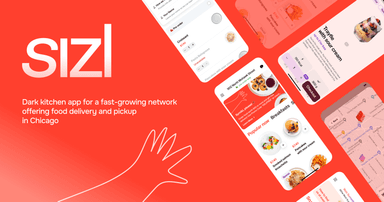
Sizl: a delivery platform for a dark kitchen chain in Chicago
Case study
What runs in our DevSecOps pipeline on every push
Every project at dev.family, current and new, pulls the same security template into its CI pipeline. It's part of project setup, the same as code review. On every push, the pipeline runs four jobs:
Check | Tool | What it looks for | What happens on a finding |
|---|---|---|---|
Secret scanning | Gitleaks | API keys, tokens, private keys and passwords in the pushed commits | The pipeline fails; the log shows the file, line and commit |
Dependency and config scanning | Trivy | Known CVEs in lockfiles; risky settings in Dockerfiles, Terraform and Kubernetes manifests | Critical: the pipeline fails. High: listed in the merge request |
Static analysis (SAST) | Semgrep | SQL injection, unsafe file handling, user input passed to eval() or a shell command, in PHP, JavaScript, TypeScript, Python, Go, Java, Ruby and C# | Listed in the merge request |
Security gate | Our own job | One summary of all results | Fails if a secret was found or if secret scanning didn't run |
The scanners start as soon as the pipeline does. They don't wait for the build, and a manual production deploy can't hold them up. The template runs on GitLab's free tier, so no project needs a paid license to get it.
Secret scanning: what happens when a key lands in a commit
Secret scanning, also called secret detection, checks every new commit for API keys, tokens, private keys and passwords. A hit fails the pipeline, and the log shows the file, the line and the commit. The developer removes the secret, and the credential gets replaced with a new one. Deleting the line isn't enough, because the old value stays in history.
By default, the scanner reads only the commits in the current push. A green check on day one says nothing about the years of history behind it. So when a project connects the template, we run a one-time scan of every branch and every commit, and we treat anything it finds as exposed.
From practice. Most of our repositories came back clean. One didn't, on the first day. When Dmitry, our DevOps engineer, connected the scanner to a mobile app project, it flagged an Apple private key file (.p8) sitting in the repository. Nothing in the code used it; it had most likely been committed by accident.
On most of our projects, the secrets are clean. But on the very first day I connected the scanner to one of them, it fired.
A key like that gets the same treatment as any leak: revoke it with the issuer, create a new one, then remove the file. Removing the file alone would have left a working key in git history.
Going through a security review with procurement or IT?
We share our security pack under NDA.
Dependency scanning: how one fix reaches every project
Trivy checks every lockfile in the repository, such as composer.lock, package-lock.json, yarn.lock, go.sum and poetry.lock, against databases of known vulnerabilities. It also reads Dockerfiles, Terraform and Kubernetes manifests for risky settings, for example a container that runs as root.
Projects pull the template instead of keeping their own copy, and Trivy downloads a fresh vulnerability database on every run. So when a critical CVE is published for a PHP package, the next pipeline on every PHP project checks against it. The pipeline fails on each project that uses the package until someone updates it. Nobody has to remember which repository uses what.
The same goes for our own changes. When we add a check, tighten a rule or fix a false positive, we edit one file, and every project runs the new version on its next push.
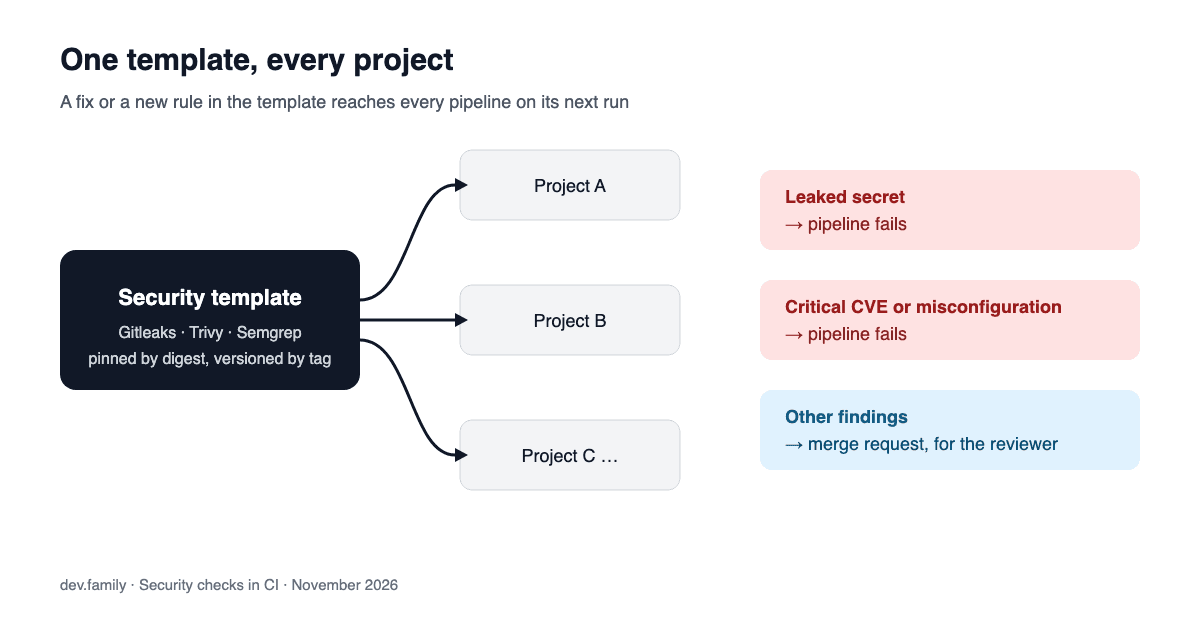
What turns the pipeline red, and what goes to the reviewer
Two kinds of findings fail the pipeline: a leaked secret, and a critical vulnerability or misconfiguration. Both need a fix before the change ships. A leaked secret has to come out of the code and be replaced. A critical CVE has to be patched, or the package upgraded.
Everything else, including Semgrep findings and high-severity CVEs, goes to the merge request. A first static analysis run on a real codebase returns dozens of findings, and many of them are low risk or false positives. If each one failed the pipeline, engineers would learn to silence the tool. In the merge request, the reviewer sees what a change added or fixed and decides what to handle now and what to schedule.
The gate also fails if secret scanning itself crashes. A green pipeline that skipped the secret check would hide the one problem we never let through.
How we change the checks without breaking projects
Projects connect the template by a version tag. A change first runs on a test project with a planted key, unsafe code and an outdated library, and that pipeline has to come out red. Then we move the tag, and every project gets the change. To roll back, we move the tag to the previous version.
We also pin the scanner images to an exact SHA-256 digest. A Docker tag can be overwritten, and in March 2026 attackers did exactly that: they used stolen credentials to push Trivy images with credential-stealing code to Docker Hub under ordinary version tags, according to Docker's write-up of the incident. Aqua Security's advisory says users who referenced the images by digest weren't affected.
AI-generated code goes through the same checks
Code from AI assistants needs the same checks as code people write. In Veracode's 2025 GenAI Code Security Report (July 2025), code from more than 100 language models introduced security flaws in 45% of the coding tasks tested.
Our scanners don't know who wrote a line. Code from an AI assistant gets the same secret scanning, static analysis and dependency scanning as code a developer typed, and a person still reviews the merge request.
What automated checks don't cover
Scanners find leaked keys, risky code, known CVEs and config mistakes. They can't tell you where guest data is stored, who can read it, which processors receive it, or how a deletion request reaches every system. Those answers come from design and contracts. We cover them in a data flow diagram and a DPA, both part of the security pack. Access control and business logic need people too. For the operational side of restaurant security, from POS vulnerabilities to phishing, see our earlier piece on restaurant cybersecurity threats.
The Role of AI in Enhancing Restaurant Cybersecurity
Read also: the operational side of restaurant security, from POS vulnerabilities to phishing
Planning a new ordering, loyalty or integration project?
An assessment takes 2–4 weeks at a fixed price and ends with a fixed Build estimate your IT team can review.
Questions to add to your vendor security questionnaire
These seven questions show how a development partner handles your code and keys. Ask for specifics: tool names, what fails the pipeline, what happened the last time something was found.
Question | A good answer | Red flag |
|---|---|---|
What runs automatically on every push? | Named tools for secrets, code and dependencies, on every project | "We do code review," with no tooling behind it |
Which findings fail the pipeline? | A clear rule, such as leaked secrets and critical CVEs | Nothing ever fails the pipeline |
If a developer commits an API key and deletes it in the next commit, what happens? | The key is revoked and a new one is issued | "We deleted it" |
Have you scanned the full git history of our repository? | Yes, once at setup, with every finding rotated | Only new commits are checked |
When a critical CVE is published, how soon does every one of your projects know? | On the next pipeline run, through a shared template | Each team checks on its own |
Are your CI images pinned to a digest? | Yes, by tag plus digest | "We use latest" |
How do you handle AI-generated code? | The same checks and review as any other code | No policy |
If you're comparing partners on more than security, start with these red flags when hiring a development agency. The way we run projects, from the first assessment to production support, is on our restaurant technology consulting page.

5 Red Flags When Hiring a FoodTech App Development Agency
Read also: what to check before you hire a development partner
FAQ
Last updated: November 24, 2026


