

At Inamo in London's Soho, guests have been ordering from projected, interactive tabletops for close to two decades — proof that restaurants will adopt unusual interfaces the moment those interfaces make ordering easier. Augmented reality is the next step in that line, and it has moved past the demo-booth stage: the global AR market is on track to grow from $120.2 billion in 2025 to $1.05 trillion by 2033, a 29.7% annual growth rate, according to Grand View Research's June 2026 market report. Restaurants are a small slice of that market today. They won't stay that way for long.
For restaurant operators, an AR restaurant menu or an AR-powered staff training module can already work technically, running on hardware every guest and every new hire already carries. What actually matters is which use case pays back fastest for a specific operation, what it costs to build, and how it plugs into the POS, loyalty, and ordering systems already running the business. This article walks through four use cases with measurable upside — AR menus, visual upselling, staff training, and AR marketing — plus the technical architecture and real cost ranges behind each one.
As a FoodTech mobile development team, we see the same pattern across restaurant clients: the question about AR menus comes up in almost every conversation now. The technology has crossed the threshold from experiment to business tool, and the build complexity is lower than most operators expect.
The Business Case: What the Data Says About AR in Restaurants

Two separate trends are converging on restaurant technology budgets right now. The first is macro: augmented reality overall is one of the fastest-growing technology categories tracked by Grand View Research, with food service listed among the sectors expected to adopt AR tooling as costs fall and WebAR removes the need for a dedicated app. The second is operator behavior: restaurants are already comfortable adopting technology that was experimental five years ago — 26% of restaurant operators now report using AI-related tools in daily operations, per the National Restaurant Association's State of the Restaurant Industry 2026 report. AR is following the same adoption curve AI just climbed.
Inside that macro trend sits a more specific, commercially interesting data point. Kabaq, one of the more established AR menu platforms, reports average order value increases of 20-26% within the first 90 days across its restaurant operator network — figures the company attributes to a simple mechanism: when a diner sees a true-to-scale 3D render of a dish before ordering, they commit with more confidence and less hesitation. That's a vendor-reported figure rather than an independently audited one, and it's worth treating it that way — as directional evidence of a real effect, not a guaranteed outcome for every menu.
The adoption gap is the opportunity. Augmented reality food ordering remains rare outside a handful of pilot deployments in the US and UK independent restaurant market. An operator who deploys one in 2026 is still an early mover, and in hospitality, being genuinely novel carries measurable value in social sharing and word-of-mouth — on top of whatever the order-value data delivers on its own. Solutions built for AI and emerging tech in FoodTech increasingly treat AR as the next module in the same roadmap, not a separate initiative.

AI Trends in Food and Beverage: What Actually Works for Restaurant Chains and Dark Kitchens
Curious how AR fits next to the AI tools you're already evaluating? Here's the wider technology picture.
An augmented reality restaurant menu app works in a straightforward way: a diner scans a QR code at the table, and instead of a photo, a photorealistic 3D model of the dish appears on the table surface at true scale. They can rotate it, view it from any angle, and know precisely what's arriving before they order. That's the whole pitch, and it's a strong one — ordering uncertainty is the single biggest source of order-value hesitation and post-meal disappointment.
There are two ways to build this. A native AR app, using ARKit on iOS or ARCore on Android, delivers the best rendering quality: full depth tracking, realistic shadows, accurate light estimation. The catch is that a diner has to download an app first, which is the right trade-off for a restaurant that already has its own branded app and wants AR embedded inside it — a case we cover in more detail in how to create a restaurant app.

A WebAR restaurant menu is the other path, and it's the dominant choice for new deployments in 2026. A diner scans a QR code, the browser opens, and AR launches through WebXR or a platform like 8th Wall — no download, no app store friction, and it runs on any recent iPhone or Android device. Menu updates happen through a CMS dashboard rather than an app resubmission, which matters more than it sounds: menus change weekly, app store review cycles don't.
For restaurants that don't want custom development, SaaS AR menu platforms exist specifically to lower the barrier. Kabaq is the most established, offering photorealistic 3D food scanning and WebAR delivery to a network the company describes as 800+ restaurants. HoloMenu and Dine AR occupy similar territory. Setup typically runs $1,500-5,000, which is a reasonable price to test whether AR moves the needle for a specific menu before committing to anything custom. Custom development becomes the right call once a restaurant needs its own branded app, POS-synced menus, a distinct visual identity, or centralized content management across multiple locations — a decision point we break down further in Restaurant Tech Stack 2026.
Not sure whether a SaaS AR menu or a custom build fits your operation?
Book a 30-minute call with our team — we'll look at your current stack and tell you honestly which path pays back faster.
Use Case #2 — Visual Upsell: How AR Increases Average Check Without Pressure Selling
Ask how restaurants use AR to increase sales beyond the menu itself, and visual upselling is usually the answer. Traditional upselling is verbal, and it has a ceiling: a server asks if the table wants dessert, some guests feel pushed, and conversion stays modest because the ask depends entirely on timing and delivery. Restaurant AR upselling changes the mechanism from verbal to visual. When a diner is browsing a dish in an AR menu, the interface can surface a "pairs well with" recommendation as its own 3D model — a glass of wine, a side, a dessert — and the diner decides on their own, prompted by appetite rather than a pitch. Kabaq's operator network reports conversion rates for these AR-prompted upsells running roughly 3.4x higher than staff-verbal upsells — again, a vendor-reported figure, and one that lines up with the broader logic of the format: visual suggestion at the moment of decision beats a sales ask after the decision is basically made.

The same interaction pattern extends to portion visualization. A guest deciding between a small and large pizza can see both at true scale before choosing, which cuts down on the post-order regret that drives downgrade requests and comp'd replacements. It also does quiet work for accessibility: a guest with dietary restrictions can see a gluten-free, vegan, or halal tag rendered directly on the 3D model, removing a barrier that would otherwise require asking a server and waiting for an answer — a small UX detail that disproportionately affects a growing, often high-value segment of diners.
Building this is less work than it sounds, because it's mostly an extension of the AR menu you'd already have. The upsell logic lives in the menu CMS as a recommendation ruleset — "pairs with," "commonly ordered together," "same-course alternative" — that triggers a second 3D model load when a diner taps the suggested item. No new AR engine, no new rendering pipeline, just a rules layer on top of what's already there. The same personalization data that powers this kind of upsell is exactly what feeds smarter loyalty offers over time.

Smart Restaurant Loyalty Programs That Boost Profit Without Killing Margins
Tired of upsell scripts that either get ignored or annoy the table? Here's the mechanics of turning order data into offers guests actually want.
Use Case #3 — AR Staff Training: The ROI Nobody Talks About
AR training doesn't get the attention AR menus do, but it solves two problems the restaurant industry has struggled with for years: high staff turnover and training windows that keep shrinking. A new hire typically has one to two weeks to learn food safety procedures, plating standards, and service protocols. Video-plus-shadowing is the default method, and it's slow, inconsistent, and prone to first-month mistakes that cost more than the training itself.
The closest large-scale precedent for immersive frontline training didn't use AR — it used VR, and it's worth citing directly because the results are unusually well documented. McDonald's deployed VR-based crew training across more than 150 franchise locations, training over 4,224 crew members between January 2020 and April 2021, according to Training magazine's reporting on VR adoption in the QSR industry. A PwC study cited in that same reporting found VR-trained employees completed training roughly four times faster than traditional methods and reported 275% more confidence in the skills they'd learned. That's a headset-based VR pilot from a few years back, not a live AR statistic — but it's the clearest evidence available that immersive, hands-on training format beats video-and-shadowing by a wide margin, and AR extends the same principle to a phone or tablet camera instead of a headset.

AR training overlays instructions directly onto real equipment: a new cook points a tablet at the pass and sees an exact plating diagram superimposed on the actual plate in front of them; a front-of-house hire sees a table-setup guide rendered over the real table. Technically, this reuses most of the AR menu stack — ARKit and ARCore for object recognition, Unity for rendering the overlay instructions, all wrapped in the same modular architecture that lets training content update without touching the underlying app. The financial logic scales with headcount: any chain cutting weeks off onboarding time captures savings proportional to how many new hires it processes in a year, which in an industry defined by turnover is not a small number. Getting the operational side of that turnover problem under control is the same discipline behind building delivery systems that let dark kitchens grow without multiplying headaches at each new location.


Onboarding eating into every manager's week? Message us on linkedin or start a project evaluation — we'll walk through what an AR or hybrid training module would actually take for your team size.
Max B., CEO
Use Case #4 — AR Marketing: Campaigns That Generate Organic Reach
AR marketing gives restaurants something that's genuinely hard to buy: a branded experience guests film and share themselves. Three formats show up repeatedly. Social AR filters, built on platforms like Instagram's Spark AR or Snapchat's Lens Studio, let a diner point their camera at a dish and trigger an animated overlay, a hidden discount, or a loyalty reward — a low-cost, high-shareability tactic for a menu launch or seasonal item. Packaging-based WebAR takes the same idea home: a QR code printed on a pizza box or a coffee cup launches a branded AR experience — a mini-game, an animated mascot, a reward reveal — the moment a guest scans it after delivery, at close to zero incremental production cost once the WebAR experience exists. Virtual restaurant walkthroughs, delivered through a Google Business listing or a booking page, let a prospective guest see the room and the atmosphere before they ever book a table.

None of these formats has one universally quoted ROI number worth repeating as fact — most operators running them don't publish exact figures, and the ones that circulate online rarely trace back to a verifiable source. What's consistent across the format, though, is the mechanism: AR dining moments are inherently filmable, and a single organic video or Reel does more for reach than a comparable ad spend, precisely because it isn't presented as an ad. For a chain trying to reduce how dependent it is on paid acquisition and third-party platforms, that's the same logic behind choosing owned delivery over aggregator dependence — building a channel guests come back to directly, instead of renting attention every time.

QSR Own Delivery vs. Aggregators: What Restaurants Are Actually Choosing in 2026
Want a marketing channel that doesn't run through someone else's algorithm? Here's the broader case for owned digital experiences.
The Technical Stack — How AR Restaurant Apps Are Built
For a restaurant operator, the practical question behind any AR app development for a restaurant is what actually needs building. For anyone evaluating vendors, it's a useful checklist. Three technology branches cover essentially every ARKit/ARCore restaurant app deployment today.
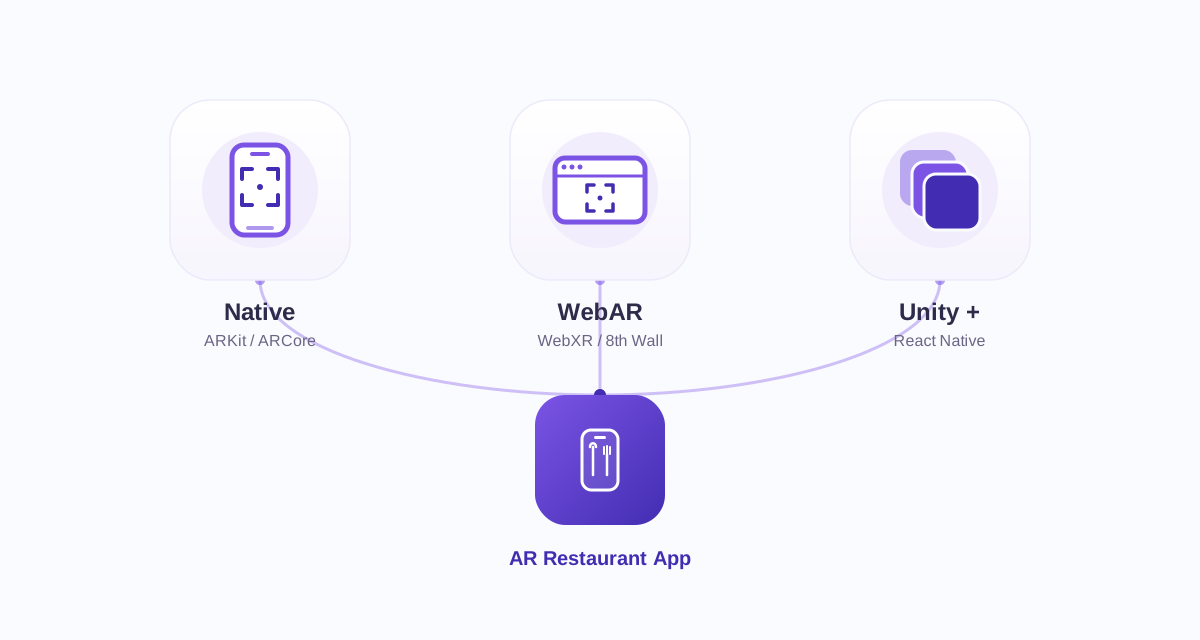
ARKit (iOS) and ARCore (Android) are the native AR engines built into each operating system. They deliver the best visual fidelity — depth tracking, realistic shadows, accurate light estimation — and are the right foundation when a restaurant already has its own app and wants AR embedded natively inside it. WebXR, usually paired with a platform like 8th Wall, runs AR directly in a phone's browser: a diner scans a QR code and the experience loads instantly, no install required. This is the dominant choice for new deployments in 2026, because app-download friction is the single biggest killer of AR interaction rates. For heavier experiences — staff training modules, more immersive dining formats — Unity handles the 3D rendering while React Native provides the app shell around it, the same combination we cover in detail in Integrating Unity Code into React Native, since it's the pairing behind most of the mobile development work we do for FoodTech clients.
Underneath the AR engine, three components determine whether the deployment actually works day to day. First, the 3D model pipeline: photogrammetry scanning of real dishes (a service Kabaq offers directly) or manual 3D modeling, and the quality bar matters — a low-fidelity 3D render converts worse than a good photograph, so this isn't a place to cut corners. Second, menu CMS integration, so that AR models update the moment a dish changes in the menu system, through the same webhook or API-sync patterns used for other POS integrations. Third, an analytics layer tracking AR interactions, dwell time per dish, and conversion from AR view to order — data no static menu has ever been able to produce.
That second component is the one operators underestimate most. An AR menu without POS integration looks impressive and creates an operational gap: update a price or pull a dish in the POS, and the AR model keeps showing the old version until someone remembers to update it manually. For any multi-location deployment, POS sync is what keeps the kitchen trusting the tool — skip it, and the AR menu quietly drifts out of sync with what's actually being served.
Cost and Timeline — What to Expect
How much does an AR menu app cost? Pricing splits cleanly by build type, and AR menu app development costs depend mostly on whether a restaurant already has its own app and whether POS integration is required.
Tier | What's Included | Cost | Timeline |
|---|---|---|---|
SaaS AR menu (Kabaq, HoloMenu) | 8-12 hero dishes in WebAR, table QR codes, CMS for updates | $1,500-5,000 setup + $100-300/mo | 2-4 weeks |
SaaS + custom branding | Full AR menu, custom interface design, Instagram AR filter | $5,000-18,000 | 4-8 weeks |
Custom WebAR menu | Own WebAR platform, full POS integration, custom analytics | $20,000-50,000 | 8-14 weeks |
Custom native AR app | ARKit/ARCore native app, AR menu + upsell + loyalty integration | $50,000-150,000+ | 16-24 weeks |
AR staff training module | ARKit/ARCore + Unity, kitchen workflow guides, updatable modules | $30,000-80,000 | 12-18 weeks |
SaaS is the right starting point when a restaurant has no existing app, no POS-integration requirement, and a standard visual-menu use case across one to three locations without near-term plans to scale — speed matters more than customization, and 2-4 weeks beats 8-24 weeks by a wide margin. That said, these figures track the general shape of restaurant app development costs more broadly: complexity and integration requirements move the number far more than the base feature list does.
Custom development earns its higher price and longer timeline in specific situations: when AR needs to live inside an existing branded app rather than as a separate experience, when POS integration is non-negotiable because menus change frequently, when a multi-location chain needs centralized control over AR content, when the upsell layer needs to plug into loyalty-based personalization, or when the use case is staff training — a category where SaaS platforms are essentially nonexistent. For operators still validating whether AR is worth a custom build at all, starting with a SaaS pilot and graduating to custom once the data justifies it follows the same phased logic we lay out in MVP Development for FoodTech Startups.
Got a project in mind?
If you're looking for a technology partner who can scope this honestly — SaaS pilot or custom build — we'll get back to you at short notice.
Takeaways
- AR menus are the most commercially proven restaurant AR use case: 3D visualization removes ordering uncertainty, and Kabaq's operator-reported data points to order-value increases of 20-26% within 90 days — treat that as directional, vendor-reported evidence, not an audited guarantee.
- WebAR (via WebXR and platforms like 8th Wall) is the default choice for new deployments in 2026, because app-download friction is the biggest single drag on AR interaction rates.
- Visual upselling — "pairs well with" recommendations as 3D models — converts better than verbal upselling because the guest decides on their own, prompted by appetite rather than a pitch.
- AR staff training is underrated: the closest hard data comes from McDonald's VR pilot (150+ locations, PwC-measured 4x faster training completion), and AR extends the same logic to a phone or tablet instead of a headset.
- Treat POS integration as a requirement, not a nice-to-have, for any serious AR menu deployment — skip it, and AR models drift out of sync with what's actually on the menu.
- Start with a SaaS pilot ($1,500-5,000, 2-4 weeks) if there's no existing app or POS-integration requirement; move to custom development once a specific use case — branded app, multi-location management, staff training — demands it.
Thinking about AR for your restaurant?
Describe your stack and goals — we'll tell you what actually makes sense to build, and what doesn't.


